
Sweden offers a well-developed investment ecosystem with options ranging from low-cost index funds to more complex exchange-traded products. Whether you are building long-term wealth or exploring shorter-term trading strategies, understanding the available instruments helps you make smarter decisions from day one.
Quick Facts
- Best for: New and experienced investors looking to understand the Swedish market
- Core instruments: Mutual funds, individual stocks, bonds, ETPs
- Regulation: Supervised by Finansinspektionen (Swedish Financial Supervisory Authority)
- Tax advantage: ISK accounts (Investeringssparkonto) simplify tax reporting on investments
1. Mutual Funds (Fonder)
Mutual funds are a cornerstone of the Swedish investment landscape, offering a convenient way to achieve diversification across multiple securities with a single purchase.
Stock funds (Aktiefonder) are common for long-term growth, as they invest in shares to seek high potential returns, though they carry higher risk than bond-focused alternatives.
Index funds (Indexfonder) have gained significant popularity as cost-effective, passive options that track specific market indices like the OMXS30, making them ideal for hands-off investors who want broad market exposure without high management fees.
For more conservative investors, fixed income funds (Räntefonder) focus on lower-risk assets like bonds and government securities, providing steadier returns with less volatility.
Mixed funds (Blandfonder) provide a balanced approach by combining stocks and bonds, with the allocation often adjusted by managers to suit market conditions. This makes them a flexible middle ground between growth and stability.
Additionally, hedge funds (Hedgefonder) operate as special funds with flexible investment rules, aiming for positive returns in both rising and falling markets, though they typically require higher minimum investments and carry greater complexity.
*A snapshot of the Swedish investment market, where mutual funds remain a popular choice for long-term savers.*
2. Individual Stocks (Aktier)
Direct investment in stocks represents an ownership stake in a company, giving investors a share of its profits and growth potential.
Many Swedish investors look for companies that offer dividends (Aktieutdelning), which are a portion of the company’s profit distributed to shareholders, providing a regular income stream alongside potential capital appreciation.
While most people trade on regulated exchanges like Nasdaq Stockholm, some invest in unlisted companies (Onoterat), which are not listed on a public exchange and typically involve higher risk and lower liquidity. These investments require more due diligence and often come with longer holding periods.
Swedish blue-chip stocks in companies like Volvo, Ericsson, and H&M are popular choices among retail investors, often available through domestic platforms like Avanza or Nordnet.
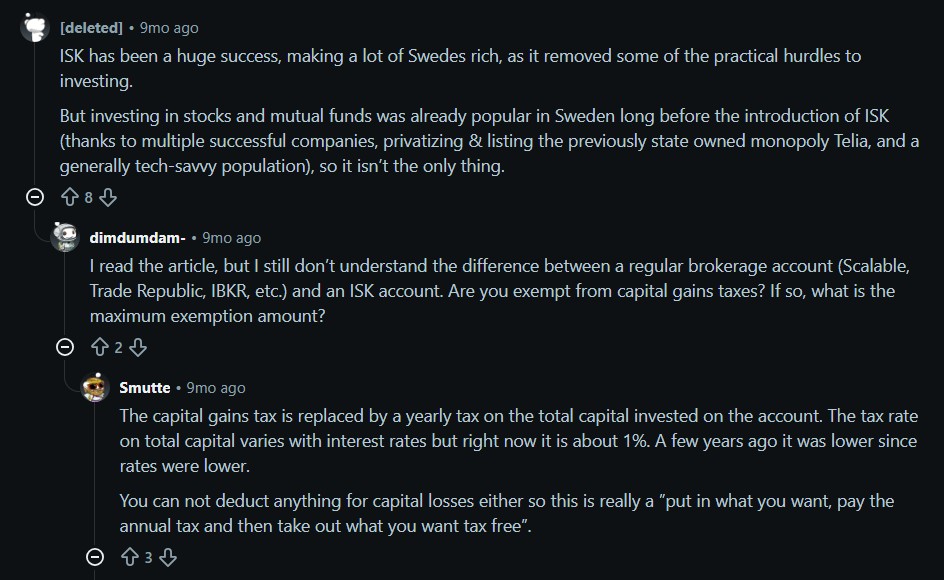
*Swedish investors frequently discuss strategies and share insights on platforms like Reddit, helping newcomers navigate the local market.*

3. Bonds (Obligationer)
Bonds act as debt securities where the investor essentially lends money to an issuer in exchange for regular interest payments and the return of principal at maturity.
Government bonds (Statsobligationer) are generally the lowest-risk option as they are backed by the Swedish state, making them a popular choice for capital preservation during uncertain market conditions.
Corporate bonds (Företagsobligationer) are issued by companies and usually offer higher yields than government bonds to account for increased credit risk, providing better returns for investors willing to take on additional default risk.
Other specialized instruments include housing bonds (Bostadsobligationer), which fund mortgages and are a key part of Sweden’s housing finance system, and green bonds (Gröna Obligationer), which are earmarked for projects that benefit the environment, appealing to investors with sustainability goals.
4. Exchange-Traded Products (ETP)
Investors seeking more active trading options often use ETPs, which are traded directly on the stock exchange with real-time pricing, combining flexibility with transparency.
Exchange-Traded Funds (ETFs) are popular for combining the diversification of a fund with the flexibility of a stock, allowing investors to buy and sell throughout the trading day while gaining exposure to a basket of securities.
Other common ETPs include warrants, which follow market trends and offer leveraged exposure, and Bull and Bear certificates, which allow investors to take positions on market movements, often using leverage to amplify daily changes.
ETPs listed on Nasdaq Stockholm or other Swedish exchanges are accessible through most brokerage accounts and are particularly popular among younger investors who prefer digital platforms for managing their portfolios.
Frequently Asked Questions
Do I need a Swedish personal number to invest in Sweden?
Yes, most brokerage platforms require a Swedish personal number (personnummer) and a Swedish bank account to open an investment account.
What is an ISK account and why should I use one?
An ISK (Investeringssparkonto) is a tax wrapper that simplifies investment taxation in Sweden. Instead of paying capital gains tax on each sale, you pay a flat annual tax based on your account value, which is often more favourable for long-term investors.
Are there any restrictions on foreign investments?
Swedish residents can invest freely in both domestic and international markets. However, some tax advantages like ISK benefits apply primarily to investments within the account itself.
Match the Account Type to Your Goal
Sweden’s investment landscape offers something for every risk tolerance. Use an ISK for long-term growth with flat tax, a KF for insurance-wrapped products, and a regular securities account if you trade frequently or hold foreign instruments. Start with low-cost index funds, add individual stocks once you understand your risk profile, and let the account structure do the tax work for you.